

I had the opportunity to sit down with the developers behind closed doors at GDC 2026 in San Francisco, where they presented a live one-on-one demo of Crimson Moon, their upcoming solo and co-op action adventure RPG. ProbablyMonsters is an AA studio that has been quietly building something ambitious, and what I saw in that room gave me reason to pay attention. The studio is intent on bringing its own flavor to a saturated genre and alongside it, delivering a visually arresting world with a considered design philosophy underpinning the whole thing. This is not a game that is trying to be everything to everyone. The developers gave me the impression that they know what Crimson Moon wants to be and that they intend to execute on that identity with real confidence.
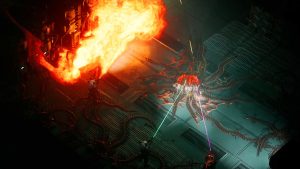
Crimson Moon lives up to at least half of its name. The first thing you notice when you watch the trailer for this action-adventure RPG is the color red. Your character is draped in it, the environments are soaked in it, and your enemies will be spilling a great deal of it. It is an immediately striking visual choice that gives the game a bold, distinctive identity from the first frame.
The artists at ProbablyMonsters deserve real recognition here. The architecture of Gildenarch is extraordinarily detailed and ornate; the kind of environment design that rewards you for simply standing still and looking around. It kind of reminds me of the first Darksiders game. There is a gothic grandeur to every space that somehow coexists with the visceral chaos of the combat playing out within it.
Unreal Engine 5 has become something of a great leveler in the industry, giving studios of all sizes access to a level of visual fidelity that would have been unthinkable a generation ago. Probably Monsters has clearly made good use of what the engine offers and has added its own flavor to it.

Q: One of the first thing that you immediately notice when watching Crimson Moon are the visuals. The cathedral seems very detailed and you have striking red hues, golden ornaments and angelic statues. How do you approach building spaces that feel both sacred and corrupted simultaneously?
A: Thanks for noticing that! It’s very intentional and comes from the original idea of Game Director David Lesperance and the artistic vision of Art Director Oliver Regueiro. We’re obviously huge fans of this genre but a lot of gothic and medieval games look gray or dark or monochromatic. We want to give this game a really unique and distinctive look that is fun and vibrant. We also want to showcase some of the talent of our environment artists and technical artists by increasing the level of detail, and it makes the architecture and characters come alive.
Q: The lighting in the environments looks phenomenal, with candlelight, fire and what seems like divine radiance all coming together in the same space. How much of that is real-time lighting through Lumen and how did you use it to serve the Gothic atmosphere rather than just showcase the technology?
A: The lighting in Crimson Moon uses the real-time Lumen technology built into Unreal Engine 5.6. Our level and art design teams have carefully placed light sources throughout the world of Gildenarch with a close eye on different types of lights and nearby surfaces.
For the gritty atmosphere of Crimson Moon, we wanted the lighting and darkness to reflect the conflict between the forces of heaven and hell. Players will find glorious, shining monuments, but they should also expect that darkness is always nearby.
Q: UE5 is a powerful engine, but it’s also notorious for its challenges around stuttering, shader compilation and memory demands. What has been the hardest technical battle you’ve had to fight building Crimson Moon on UE5 and how have you solved it?
A: Unreal Engine 5 is a really powerful tool, including that it can be modified. ProbablyMonsters’ central technology has made some custom changes to the engine to implement some developer functions that we prefer internally and make other improvements to the tech. These are made available to all of our internal development teams, including the team working on Crimson Moon. With these adjustments, we haven’t had any major technical problems working with Unreal Engine 5, and our biggest ‘fights’ have been with hellspawn!
What I saw of the combat left me wanting to grab the controller off the hands of the chap that was playing it. Not because he was terrible at the game or anything, but because the combat felt visceral and satisfying; weighty and purposeful.
The game has the staple moveset you tend to find in your soulslike games with the dodges, rolls, parries and counters as well as other magical abilities and transformations that come with being a Nephilim; a half-human half-angel warrior.
The game seems tough but not to the extent of being exclusionary. I think the co-op feature will be a particular highlight for the title and I reckon a fair few people will pick this up specifically with a friend in mind.
Q: Crimson Moon blends Gothic High Renaissance aesthetics with Souls inspired combat and roguelite replayability. What was the original creative spark for the game and how did that vision evolve into what we’re seeing now?
A: The original spark for the game started with David and Kyle Lesperance and Brendan Simard as teenagers in Michigan, feeling inspired by Dungeons & Dragons, heavy metal music, album artwork, and things like that. David, Kyle, and Brendan are now Game Director, Narrative Designer, and Gameplay Programmer, respectively, on Crimson Moon, and they’ve fused their inspirations with their love for action-adventure RPGs to shake up the genre with a replayable mission structure. This allows the game to still be thrilling while reducing potential player frustration. That’s been the design concept from the beginning. The biggest evolution during production has been re-scoping the size of the game to allow the team to focus on quality and replay value more than sheer size, and hit a price point that gamers love.
Q: There’s clearly a strong identity here but the market is crowded with action RPGs. What would you say is the single thing that makes Crimson Moon distinct from other games on the market?
A: Crimson Moon is structured around focused, replayable missions instead of a traditional story campaign. The game’s unique structure keeps tension high, supports repeat sessions, and allows players, whether they fight solo or with a friend, to experiment with builds and tactics while still offering an engrossing world with unique lore to unearth.
Q: If you had to pitch Crimson Moon to a fan of a specific game or games, who would you target? What’s the “if you loved X, you’ll love this” elevator pitch?
A: We made Crimson Moon for fans of action-adventure RPGs who love combat mastery and skill expression. The game is inspired by our love for classic fantasy, gothic horror, and metal music, and we believe fans of these genres will love Crimson Moon too.
Q: The fact sheet describes missions lasting 15 to 45 minutes with dynamic layouts and scaling difficulty. How does the difficulty scaling work?
A: Difficulty in Crimson Moon is one of many ways that the game is designed to be replayed. It scales through a mix of factors, including challenge modifiers, changing enemy compositions, and an evolving mission board that offers new objectives, progression paths, and escalating trials. These systems, in combination, allow players to choose the difficulty experience that fits them best, while also providing an increasing series of “high risk, high reward” challenges for players to return to again and again.
Q: Co-op is optional but clearly a meaningful part of the design, with synergies and mid-battle revival. How do you ensure the solo experience feels complete and intentional, rather than co-op being the intended mode?
A: We’re doing robust single-player and co-op testing every single day with the ProbablyMonsters QA team. They are fantastic. They’re so good at the game now; they can do speed runs, play as a beginner, or even choose how quickly or slowly health depletes or bosses are defeated. They tell us the average run time length in single player and co-op, and give us honest and direct feedback from the gamer perspective. We fine-tune statistics based on their testing, and we’ll continue to iterate by listening to community feedback in Discord through launch and beyond.
Q: Can you explain how the celestial transformation mechanic works?
A: It’s a powerful but temporary buff to a player’s combat statistics, pulling from their reserves of energy or “Angel Power.” Players have to manage that resource during combat, using just enough at the right times to stay alive and do real damage to the enemies and bosses.
Q: The Nephilim’s abilities are described as shifting and evolving. How expressive is build variety? Are we talking broadly similar runs with different flavour or genuinely divergent playstyles?
A: Players in Crimson Moon start with the choice between two base loadouts. From there, they collect armor pieces that form sets and weapons by completing and replaying missions. As players collect more items, they can customize their loadout. We encourage players to replay missions to discover all of these build items and experiment with different play styles.
Q: I cheekily issued a challenge to the dev playing the game not to die to a boss he encountered. Unfortunately, he failed to pass that challenge! The game looks suitably challenging. How hard is the game compared to others of its kind?
A: Crimson Moon is made with action game fans in mind. We want to give players the high highs of defeating tough enemies as their skills rise and the low lows experienced along the way. We built the game’s combat to be mastered, so bosses will test players’ ability to learn, adapt, and refine their precision and timing. Once they do, victory will be theirs.
Q: Gildenarch is described as a city with districts being reclaimed over time. How much does the overworld hub actually change as players progress? Is this cosmetic or does it materially affect what’s available to the player?
A: New areas of the map will bring narrative reveals and challenges, and players unlock them as they reclaim each ward of the besieged city of Gildenarch. That’s all we can share today, but we’ll have more to say about this in the future.

THE STUDIO AND INDUSTRY CHALLENGES
I am fascinated by the rise of the AA space and how it is quietly beginning to fill the vacuum left by a AAA sector buckling under burgeoning budgets and increasingly low risk tolerance. To me, this shift represents the industry starting to find its footing again, despite the horrendous job losses it has endured over recent years. ProbablyMonsters is a studio navigating exactly this moment, and I asked them how they intend to sustain themselves in an environment that has swallowed bigger operations whole.
Q: In our meeting, you described ProbablyMonsters as a AA studio. At a time when the industry is contracting severely, with hundreds of layoffs, studio closures, and major publishers pulling back on mid-tier projects, how do you make the case internally, and externally that there’s still a sustainable path for your studio in making a game like this?
A: ProbablyMonsters is built with a focused, sustainable model designed for long-term growth. We operate with centralized infrastructure that supports focused development teams, so our developers can deliver high-quality, intentionally scoped games. When teams build games with a clear vision and the right scope, they can execute at a very high level, and we see today’s players responding positively to those focused, polished projects. That approach allows us to build sustainably over time while delivering great experiences to players.
Q: What has ProbablyMonsters learned from this climate that has shaped how you structure the studio, manage development, or approach publishing? Is there a philosophy baked into how you work that you think gives you resilience others have lacked?
A: ProbablyMonsters was founded around the idea that developers should have the support and structure to do the best work of their careers. That’s part of why the company built centralized infrastructure and shared services to support development teams. At the same time, building great games requires strong alignment around craft, collaboration, and accountability. The goal is to combine strong support for teams with clear expectations about the quality of the work, and that philosophy keeps our team resilient and motivated.
Q: You’re releasing in 2026 with no price announced yet. Pricing has become a real conversation in the industry with debates around $70 games, $50 games and early access models. How are you thinking about where Crimson Moon sits and what factors are driving that decision?
A: We are not ready to reveal our price yet, but our goal is to delight players with clear value for their dollar through the dynamic replayability built into Crimson Moon’s mission structure.

CRIMSON MOON AND THE FUTURE
Q: Is Crimson Moon conceived as a standalone experience or is this the beginning of a world you want to return to?
A: The team’s mind is already racing with ideas for additional content, story, and characters, but we are focused on landing this game at the highest possible quality we can first and building a community toward a successful launch.
Q: Are you planning to roll out a demo or early access version of the game?
A: We have nothing to share at this time, but players can join the Crimson Moon Discord through playcrimsonmoon.com to stay updated on the game and our release plans. They can also wishlist Crimson Moon on Steam, the Epic Games Store, PlayStation 5, and Xbox Series X|S.
What I saw at GDC was a game that understands exactly what it wants to be; a brutal, beautiful, replayable action RPG and a world worth getting lost in…preferably with a friend. The gothic architecture of Gildenarch, the weight of the combat, the co-op synergies, the roguelite mission structure; all of it points to a team that has made some deliberate and confident decisions instead of just chasing trends or bloating the experience for the sake of it. Time will tell if Crimson Moon lives up to its early promise but stay tuned for more coverage from us on the title.