






On January 8, 2025, Sam Vallely sat down to answer his critics.
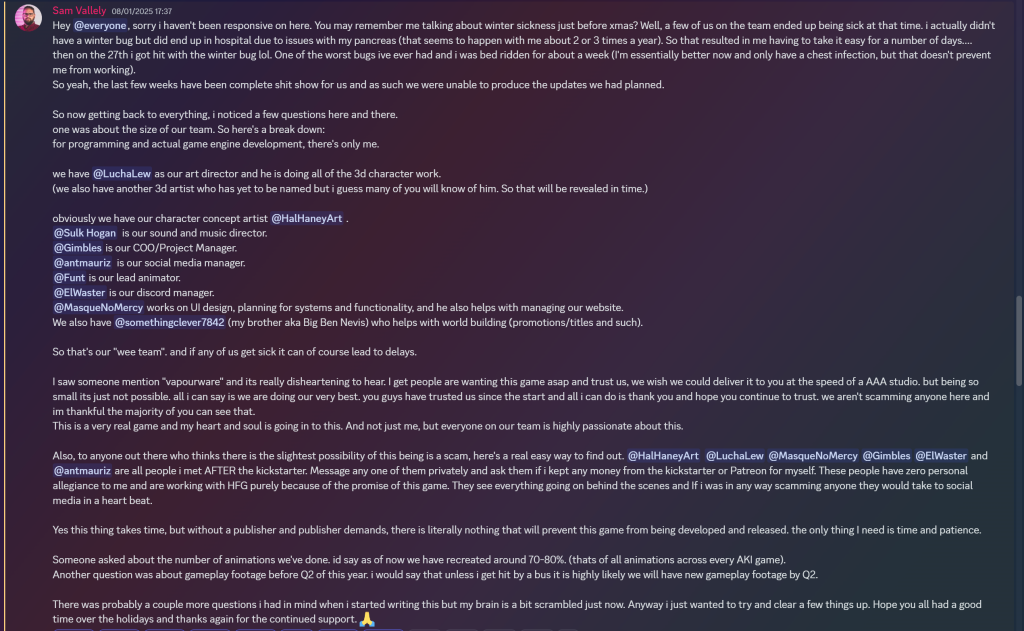
The founder of Hyperfocus Games had been quiet over Christmas, and the people funding his wrestling game had noticed. In the project’s public Discord server, someone had used the word “vapourware”. Vallely posted a long message to everyone.
He explained the silence—a spell in hospital, then a winter bug that put him in bed for a week. He set out the team, name by name, and was candid about its size.
Editor’s Note: This story features instances of vulgar language that was kept to show the nature of the conversations that were had. Discretion is advised.
“For programming and actual game engine development, there’s only me,” he wrote. Then he addressed the accusation directly.
“We aren’t scamming anyone here, and I’m thankful the majority of you can see that,” Vallely said, before making an offer that has aged quite poorly.
“To anyone out there who thinks there is the slightest possibility of this being a scam, here’s a real easy way to find out,” Vallely wrote, and listed six colleagues by name. “Message any one of them privately and ask them if I kept any money from the Kickstarter or Patreon for myself. These people have zero personal allegiance to me and are working with HFG purely because of the promise of this game. They see everything going on behind the scenes, and if I was in any way scamming anyone, they would take to social media in a heartbeat.”
Eighteen months later, five of those six people have gone.
Ultra Pro Wrestling was supposed to be the game a generation had been waiting for.
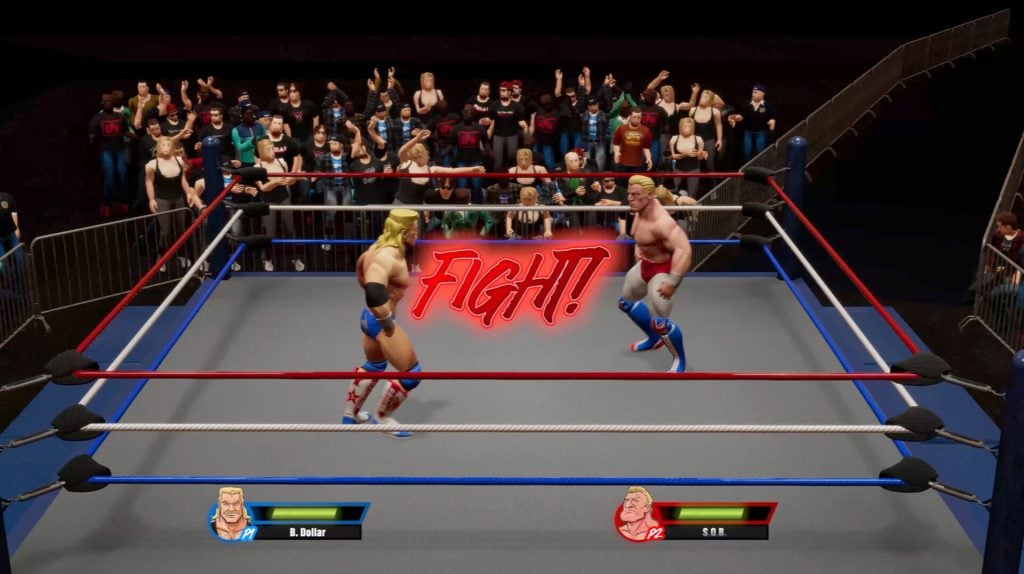
The pitch was simple and, to a certain kind of wrestling fan, irresistible: a spiritual successor to WWF No Mercy and the N64 games built on the AKI engine, titles that have spent 25 years as the benchmark nobody has managed to match.
In February 2023, a Kickstarter asking for £17,000 (⁓$24,000) cleared its target in three days and finished with £61,801 (⁓$83,000). Over the years that followed, roughly 156 wrestlers and estates signed on, among them The Hardys, Demolition, and the families of Eddie Guerrero and Chris Candido. Backers at the top tier were also promised a full-scale replica championship belt.
What followed was a slow procession of receding dates. In December 2024, replying to a prospective buyer who had only just discovered the project, the official account wrote: “It’s coming next year!”
A month later, in the same post where he invited backers to interrogate his staff, Vallely told them that “unless I get hit by a bus, it is highly likely we will have new gameplay footage by Q2.” This year, backers have been told to expect early access in the final quarter.
Today, there is no released game. There is no playable demo. There is, however, a Patreon that is still accepting subscriptions and has only recently resumed providing updates to backers.
Insider Gaming has examined tens of thousands of internal messages spanning years, executed contracts, budget documents, United States Patent and Trademark Office filings, and the project’s public record.
Together they describe something considerably worse than a small studio running late.
They show a game whose animations were extracted from other companies’ titles, a process Vallely described himself in writing. Former team members who spoke to Insider Gaming said they were not involved in that process. They show a sole programmer working without version control, who once deleted the entire project by accident and recovered it only by luck; an investor who spent more than two years asking, in writing, for a build he could run, and never received one; around 50 championship belts promised to backers, costed internally at up to $875 each, and quietly set aside when the money to pay for them never arrived; and they show a trademark application now suspended by the United States Patent and Trademark Office pending an investigation into the filings made in Hyperfocus Games’ name.
All while the CEO fails to answer most of the questions presented to him.
Thousands of Animations, Extracted From Old Wrestling Games
Late on the night of November 11, 2024, Vallely posted an update to his team.
“I’ve processed over 900 animations now,” he wrote. “Since each move is labeled with a hex code, I just gave ChatGPT the starting and end hex codes. This way I could figure out exactly how many animations there are… 5,787!”
The method he was describing is well known to people who modify old wrestling games. The AKI-engine titles store each move at a specific address in memory. With an emulator and enough patience, that data can be located, read, and converted into a format a modern engine will accept. Modders have done it for years, for free, for other fans.
Vallely was doing it to build a commercial product.
Later that day, when asked whether the animations would have to be cleaned up individually, he explained the plan.
“Smoothing them out can likely be done in a batch process,” he replied. “So that would be a script just automatically fixing each one. But hands and facial expressions will be manually with each one.”
That last clause matters. Anyone who has watched Ultra Pro Wrestling’s public footage closely has seen the hands. Fingers curled into rigid claws, held at odd angles, moving independently of the arm they belong to. It is the characteristic signature of animation data lifted from a game whose skeleton never had fingers in the first place.
By December 5, he had “processed 3,285 animations”. By June 2026 he had widened the net: “I’m now able to get all the [WCW/nWo] Revenge, and [Virtual Pro Wrestling 2] moves too, and can convert the .anim files which is what the modders use.”
And in January 2025, in the same public post where he invited backers to investigate him, Vallely told fans plainly what had been done.
“Someone asked about the number of animations we’ve done,” he said. “I’d say as of now we have recreated around 70-80%. (That’s of all animations across every AKI game).”
Nor was it only AKI. In May 2026, preparing a pitch, Vallely asked his staff whether anyone had models from AEW: Fight Forever he could use as placeholders. Internal discussions also reference models from EA’s Def Jam and UFC Undisputed series.
Put to him directly, Vallely was categorical, but precise.
“I deny that UPW has been built by importing finished animations from AKI games or Fight Forever,” he told Insider Gaming.
He did not address whether animation data had been extracted from those games by memory address, which is what his own messages describe, and what the word “finished” leaves untouched.
Insider Gaming has compared publicly released Ultra Pro Wrestling footage against the source titles frame by frame.
There is a practical consequence to all of this, and it may be the most important thing in this story. No publisher completes due diligence on a game built this way and proceeds. For four years, Vallely has told his backers that the only obstacle between them and Ultra Pro Wrestling is time and patience. The record suggests the obstacle was always going to be the game itself.
On August 30, 2026, weeks after a mass exodus from the team, and days after telling this outlet he would not engage further, Vallely published new footage for Patreon subscribers showing animation work in progress.
The description is worth quoting in full.
“Just a quick one to show some of the process with updating the animations. Also, just to clarify before anyone asks – what’s being shown here is a development side tool. This isn’t something which players will have in-game. And before anyone asks, the AI images I mention will of course not touch the actual game. Sometimes AI images are used as placeholders or to help with things like this, but all AI-generated images used in the dev phase will be completely removed from UPW upon the game’s actual release.”
It is a proactive disclosure. Nobody had asked him about AI-generated images, and his explanation—that they are placeholders and will be gone before release—is consistent with what he told Insider Gaming when he denied that AI was being used to generate the finished game.
In the video, he describes having the animations and running “a batch process” to correct them: the same pipeline he set out privately to his staff in November 2024, now described to paying subscribers.
He does not say where the animations came from, however.
Three Years of Development Came Down to One Programmer
Vallely’s January 2025 admission that he was the only programmer was straightforward, and everything else in this story follows from it. There was no second programmer, no code review, no redundancy of any kind.
There was also, for a long time, no backup.
In October 2023, he tried to put the project on GitHub, a standard tool developers use to store and version their work. He ran into file-size and filename limits, and then, in his own account to his team, “I thought ‘f*** this’ and tried to delete the git repository which somehow deleted the entire game project!”
He had backups, he told them, but had not made one in a few weeks. What saved the project was a copy he had made for an unrelated virtual-reality experiment, sitting in another folder by chance. Months of crowdfunded work were recovered by luck.
By early 2024, the project had an investor: a veteran developer with credits on Assassin’s Creed and Madden, who began sending money monthly. He asked for two things in return.
He never got either.
“Still waiting on a build,” he wrote in June 2024.
“I continue to send money regularly, but I really need the contract and a build,” he wrote a month later. “I’m keeping my end of the bargain.”
In September 2024, a build did finally arrive. “It didn’t run,” the investor reported.
The same day, the investor set out what he thought the problem was.
“Having one programmer is the problem,” he wrote. “It’s madness.”
He had been asking for a production schedule since the spring, and had already delivered the verdict that now reads as the summary of the whole enterprise.
“Games aren’t made like this,” he wrote. “Games die like this.”
By July 2025, his patience had thinned. “This fucking project has been 3 years of animations hahaha.”
He was also, by his own account, exposed. “I just don’t have anything in writing yet other than a letter of intent, and I suspect the shares of the company with the lawyers don’t have anything about me.”
Vallely’s own private assessment, delivered in a long voice message that Insider Gaming has heard, was not much more optimistic.
A Team Built on Unpaid Work and Personal Expenses
In March 2024, Hyperfocus Games had a payroll of sorts. An outsourced 3D studio in Ukraine invoiced $5,750. The art director was on $1,000 a month. An animator was on $1,250. Vallely paid himself $500. The total the project needed to cover its people each month was $8,500. It was money that came, in large part, from an investor through a middleman, by Vallely’s request, to avoid talking to the investor himself.
Vallely has been consistent that he took very little. Answering rumors in the staff channel in March 2024, he wrote: “Considering how little I pay myself (£420 a month) for the work I do (7 days a week). Also considering the additional money I’ve put back in (from the money I paid myself).”
Six months later, explaining to a staff member why his salary would not be rising, he used the same comparison. Almost everyone else was paid nothing at all.
One former employee went four years without a payment while putting roughly $10,000 into the project, including software and wrestler agreements. One even paid members of his own sub-team from his own money, including buying one of them a graphics card, on the understanding he would be reimbursed when funding arrived.
Put to him, Vallely denied it in terms.
“I also deny that HFG had a body of salaried employees who were required to work without pay or finance the project without agreed compensation.”
There was no mention of when or how those who invested personal funds into the project would be reimbursed.
The Championship Belts That Could Have Cost $44,000
Aside from the game itself, one of the most concrete promises Ultra Pro Wrestling made to its backers was also the most expensive. Supporters at the top tier were told they would receive a full-scale replica championship belt of the game’s in-game online championship, the “Global Internet Wrestling Championship”
In October 2023, eight months after the campaign closed, the studio went looking for a manufacturer and reported back to Vallely with a quote. A standard custom belt, 4mm zinc alloy on American leather, started at $675. A deluxe version with 24-karat gold plating started at $785. The top tier, CNC-etched and “closest to what’s used in the ring for most big promotions”, started at $875.
He had already given his assessment of the numbers, calling it “pricey”. Vallely then suggested the belts would be “doable” with another large investment, but admitted they’d lose a lot of money to those who paid for them. So, a promised Kickstarter tier was being pushed down the line without another investment.
At the cheapest tier available, the roughly 50 belts needed would have cost around $34,000. At the quality Vallely thought appropriate, closer to $44,000. Against a campaign that raised £61,000/$83,000, the belts alone would have consumed most of the money, a fact the project’s founder understood, in writing, eight months in.
The massive investment never arrived. In the three years since, backers have received no public update on the belts they paid for.
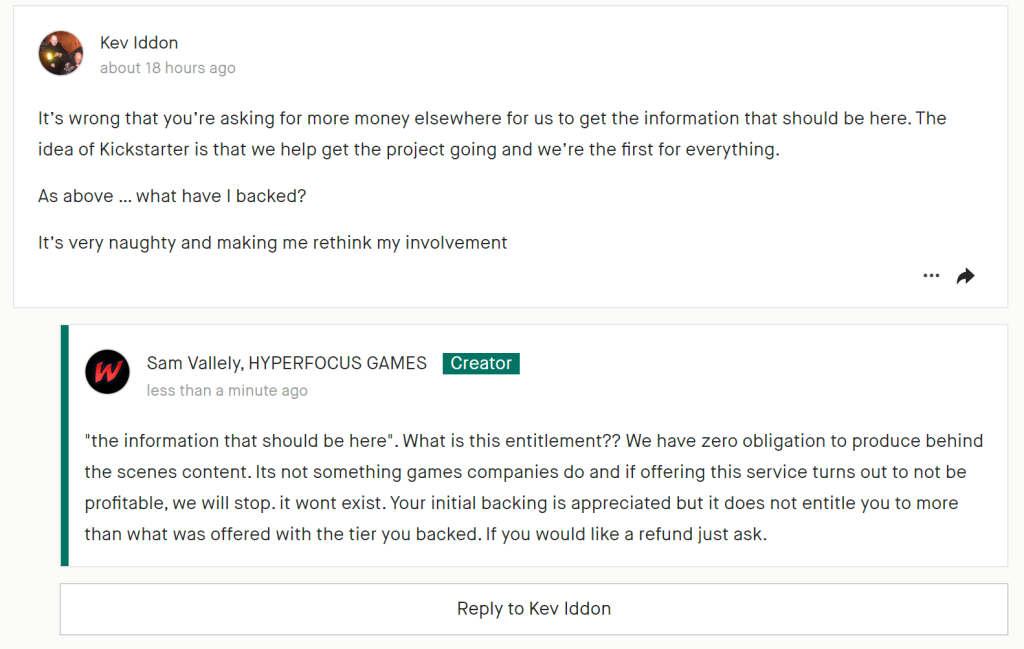
What they have received is a request for more money. In 2024, one backer, Kev Iddon, complained publicly on the campaign page that development updates were being placed behind a paywall.
“It’s wrong that you’re asking for more money elsewhere for us to get the information that should be here,” the fan wrote. “The idea of Kickstarter is that we help get the project going and we’re the first for everything. As above … what have I backed? It’s very naughty and making me rethink my involvement.”
Vallely, replying as the company, did not accept the premise.
“’The information that should be here’. What is this entitlement??” he said. “We have zero obligation to produce behind-the-scenes content. It’s not something game companies do, and if offering this service turns out to not be profitable, we will stop. It won’t exist. Your initial backing is appreciated, but it does not entitle you to more than what was offered with the tier you backed. If you would like a refund, just ask.”
“We Own AKI”: The Trademark Fight Behind the Game
Everything about Ultra Pro Wrestling’s identity rested on three letters. AKI was the Japanese studio behind WWF No Mercy and WCW/nWo Revenge, the games Vallely had promised to succeed. In 2024, Hyperfocus Games applied to register the name as a US trademark.
In December that year, it was said that the AKI IP and trademark had been acquired. Turns out, that was only partially true.
They had a pending application for the trademark, and it was about to run into trouble.
In February 2025, learning that another company had filed for a similar mark, Vallely dictated a response to be sent.
“They filed for it in September. We filed in what? November? They can eat my ass,” he wrote. “Theirs is still pending too. We have every right to challenge them.
“In fact, tell them this,” he continued. “‘Our brand is identifiable by our icon logo, and we have zero concern that their shitty 2-dollar brand would be confused with our iconic 25-plus years of recognition.’
Then, more directly: “We own AKI, and anything which uses that name as a prefix is in violation. Not the other way around.”
And finally: “I’ll write it out better. I want to include the fact that our ‘brand’ has been around for 25 years and our trademark is simply being renewed.”
Hyperfocus Games Ltd was incorporated in Scotland in 2023. It has never released a game. The 25 years of recognition Vallely was claiming belong to AKI Corporation of Japan, a separate company with no involvement in Ultra Pro Wrestling. There was no existing registration to renew.
He then requested various pieces of information regarding the trademark struggles be held from other members of the team.
The public record is unambiguous about what happened next. On June 3, 2025, the USPTO refused the application. The conflict was not with AKI Corporation at all but with AKI AKI, a registered mark held by a Delaware company for social-networking and food-delivery software.
The examining attorney also found the application had been filed unsigned, and therefore unverified, with fees paid for a single class against goods spanning three.
A second application was finally refused in November 2025. A request for reconsideration was denied on January 5 2026.
Then, on 16 March 2026, the USPTO went further.
“This application has been suspended pending administrative review of suspected improper submissions made to the United States Patent and Trademark Office in connection with this application,” the notice reads. The office is investigating whether the submissions “violate the USPTO’s trademark rules of practice, including the rules concerning signatures, certifications, and representation of others before the USPTO.”
If violations are found, the notice says, the office will issue an order to show cause why sanctions should not be imposed. It links applicants to its guidance on trademark scams.’
Internal documents eventually told staff to “avoid explicit references to AKI and ‘ripping’ in external communications when discussing our animations.”
The AI Fight Inside Hyperfocus Games
By the spring of 2026, Vallely had been alone on the engine for three years. He had just returned from an accelerator programme in London where Tencent had talked about speed, and about a world in which studios that moved faster won.
He recorded a long, exasperated message where he laid out frustrations with his art director, who had refused to work with a set of AI-generated 3D models.
“I just can’t help but sit and think about the models. Look, none of them are usable. None of them,” he said. “If this is to do with AI and this is some integrity bullshit… We now live in a world where anybody can do that.”
He could not see the objection. “Do I have that fucking reaction when it comes to programming? ‘Oh, Claude wrote it, so then I can’t get any credit’? Like, no, what the fuck? Who gives a shit?”
“It’s a fucking aversion to AI,” he concluded. “That’s how I feel. That’s all this is… that’s just holding everyone up because of your sensitive ego.”
He had checked the technical question himself, after a fashion. “I know enough about 3D modeling to be able to ask Grok, ‘Can this be done?'” he said. “Grok is telling me one thing, and then they’re like, ‘Oh no, yeah, it’d be too much work.'”
His reasoning stated plainly: “That’s kind of the whole point of this: getting the game far enough along that we put it in front of a publisher, we get enough money, and then if it’s all about integrity, we can cross that bridge when we come to it.”
The difficulty is who was being asked to cross it.
The art director was on £1,000 a month (and continued to work when unpaid for well over a year). The concept artist held a percentage of a game that did not exist. Neither had any say in the matter, and in April 2026, while planning a pitch to AEW—which, sources say, never went anywhere, nor did decision-makers at AEW know about it—Vallely proposed removing the say altogether if they would throw a “hissy fit”.
“If a decision was made to include the AI art… we don’t include them in the meeting. We need to have our business heads on here.”
Asked about it, again, Vallely told Insider Gaming: “I deny that AI is being used to generate the finished game.”
There is no finished game.
The Dispute That Tore Hyperfocus Games Apart
The end for many with Hyperfocus Games came over money and the discovery of a troubling documentary in the summer of 2026.
Some had spent four years working unpaid, while also fueling the company by paying bills and covering teammates’ expenses, and by June there was a push by those contributors for a funding round large enough to finally put the team on salaries. Vallely wanted a leaner figure. The argument ran for weeks.
But that disagreement unfolded alongside more fundamental questions about contracts, roles, production planning and what could honestly be put in front of an investor. According to former contributors, Vallely then went largely silent for almost two months.
At the center of the dispute was Hyperfocus Games’ chief operating officer, one of the project’s longest-serving contributors.
The COO—in an attempt to diminish his role, Vallely would later describe him as a “project manager”, despite having publicly presented him as the company’s COO—prepared working budget scenarios for discussion with the investor. One early draft used the salaries contributors earned in their existing jobs as reference points and included a £175,000 reserve covering possible back pay and expense reimbursement across the team. The investor was listed as an approver because, according to internal messages reviewed by Insider Gaming, Vallely had directed that financial decisions be signed off through the investor while Vallely stepped back from communication.
Vallely later alleged that the document showed the COO awarding himself founder-level compensation and setting aside £175,000 for the team. In private exchanges, the COO was accused of “looking out for the boys.”
Those documents exist, but their version history matters. A version dated three weeks later removed the provisional figures from the operational budget, isolated them on a separate scenario tab, and explicitly warned against presenting them as anyone’s approved request. Internal messages also show Vallely removing entire roles from a competing budget without consulting the people affected and using AI-generated salary assumptions rather than figures supplied by the contributors concerned.
On July 27, Vallely removed the COO without notice, a meeting, or an opportunity to answer the allegations. He was shut out before other members of the team were informed. Vallely’s private message was markedly different from the public explanation.
“You are done here,” he wrote. “COO and any other title you imagined yourself to have is officially revoked. No new role will be offered. You are not permitted to discuss any internal HFG details with anyone on the team or publicly. Doing so will be considered a breach of your NDA.”
“You fucked around, and this is where you find out.”
The title, Vallely wrote in the same message, had been “an informal title given to you simply because you and Lew [art director] persuaded me by saying it would be more impressive in emails when reaching out to talent and potential partners.”
Eighteen months earlier he had announced it himself, unprompted, to the entire community.
The non-disclosure agreement he was now invoking had its own history. When it was first issued, one recipient read it properly and refused to sign. The version he had been given included a non-compete clause running to 2030. Vallely, he explained, “had just given out this standard one from the internet.”
Most of the game’s contributors have now left. Vallely and a couple of others are the only ones remaining.
The wrestlers were affected too. In January 2026, the project’s concept artist discovered that the revenue share in talent contracts had been reduced from 50% to 35%, a change made, according to internal messages, at least a year earlier, without the talent being told.
“Did you guys lower the percentage? I told them 50%,” he wrote. “Nobody told me it was lower… they’re expecting 50, so I don’t want that to be an issue down the road. It makes us look dishonest even though it was a lack of communication.”
Of one wrestler’s family, he added: “I don’t think she even looked at the number because she was told 50; she just trusted what was told to her.”
The concept artist’s own agreement, executed through a Scottish law firm in November 2023, assigned roughly ninety-five original characters to Hyperfocus Games and waived his moral rights in them. In exchange, he receives “3.85% of the profit generated by the Transferee from the use of the Characters in the Ultra Pro Wrestling video game on PCs or console platforms after all costs, including those of the platforms, have been deducted.”
Not revenue. Profit, after all costs, on a game that has never shipped.
Vallely’s Past Comes to Light
Before Ultra Pro Wrestling, Sam Vallely made documentaries.
The first, Will Work For Free, was a film about automation and the end of employment. The second, released in the weeks after the Charlie Hebdo attack in Paris, was called We Need To Talk About Islam.
Vallely promoted it himself on Reddit, under an account that today carries the Ultra Pro Wrestling logo as its avatar.
“This is a new film from Maveric Media (producers of ‘Will Work For Free’) in the wake of the Charlie Hebdo attack,” he wrote. “But before we all jump the gun, it is not an all-out attack on Islam. It is really more of a criticism of the elements within the liberal media and those who are failing to talk about Islam openly and honestly.”
He spent the following days defending it in the comments, at length.
His own framing was that the film was not about Islam specifically. “Firstly I am an atheist,” he wrote, “and yes I use an Abrahamic religion as a vassal for the arguments against Abrahamic religions.”
At one point in his film, however, he states that “in a certain context” he could say that “all Muslims are bad”.
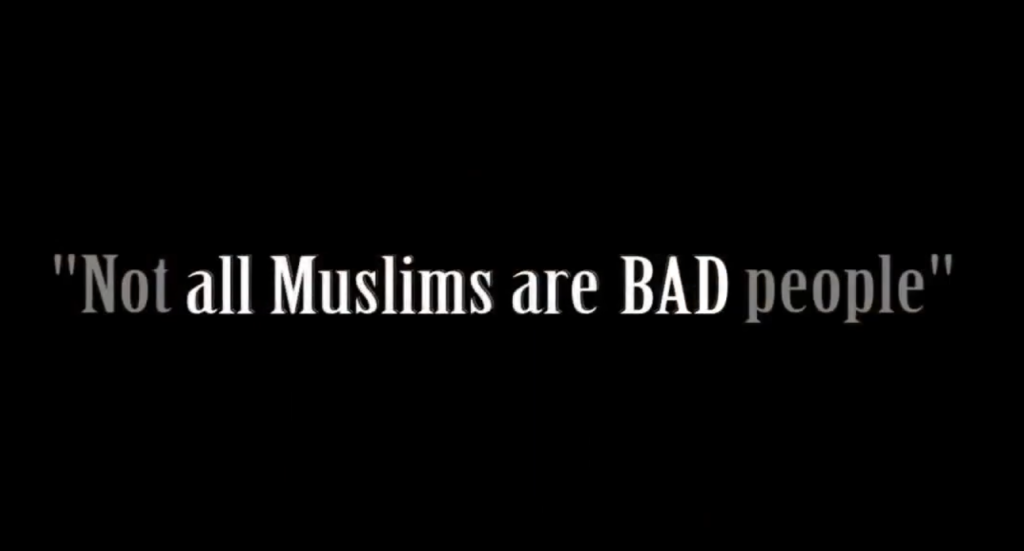
But when challenged on the substance, Vallely was less equivocal. Asked about a section of the film dealing with female genital mutilation, and told by one commenter that the film “feels more like a polarising propaganda film”, he pushed back point by point. On whether the practice could be attributed to religion rather than culture, he wrote that “it is undeniably tied to the religion today yet I think we refuse to accept this fact because we do not wish to blame religion when it comes to Islam.”
To another commenter who suggested the film should have let Muslims participate in the conversation, he replied that the film “specifically invites muslims to join it”, and dismissed the criticism as “word salad”.
Asked to clarify his view of the media, he named the broadcasters he thought were getting it right.
“I don’t mean to say that the media is liberal and we should criticise the media; I mean that we should criticise the liberal media, e.g. MSNBC, CNN, John Stewart, Russell Brand etc.. Bill Maher seems to be the only one talking about Islam honestly in liberal media, but on the other hand people like Bill O’Reilly, Hannity and Glen Beck are doing a great job of criticising Islam, and though I usually disagree with them they have been on the right side of history when it comes to Charlie Hebdo.”
The same account, in the same period, was combative elsewhere. In an argument about an unrelated documentary, he told another user: “I will however respond to your dribble for the benefit of others.”
In another, on a video game forum, he wrote: “You sound like you need friends. you can’t even handle a conversation on the internet.”
The comments are around eleven years old. The threads they belonged to have since been deleted; the replies survive on the account’s own history.
Vallely has never publicly disowned the film or his past comments. They all remain online.
Former contributors told Insider Gaming they had been unaware of the documentary until it was circulated in July 2026. Several said its contents, and Vallely’s subsequent failure to address their concerns, contributed directly to their decision to leave.
But it’s not just the documentary.
Vallely also has a public record of transphobic posts, stating in one on his personal Twitter account that “being trans isn’t really a thing” and that “no amount of make up or cosmetic surgery can make a man a woman.”
He’s even sent messages that appear to mock an employee’s name, saying “bless you” after being told their name, and following it up with “oh, that’s his name?”
Insider Gaming put the documentary and the comments to Vallely on August 20, 2026, and August 22, 2026, asking him to address the Islam documentary and his transphobic social media posts. He did not answer any of those questions in either of his replies or in subsequent correspondence. Instead, he seemingly ignored them to focus on other areas of the request.
His personal Twitter account has since been deactivated, though screenshots of his posts exist.
Vallely Denies the Allegations, Then Stops Answering
Vallely responded at length to a detailed list of questions before declining to answer any more, but failed to address some of the largest concerns.
He asked Insider Gaming to pause publication while the provenance of the material was assessed, said that contributors had been given access “subject to executed written confidentiality agreements”, and requested copies of the documents and footage on which the story relies, saying he could not responsibly authenticate or explain material he had not seen.
That request was declined: supplying it would identify confidential sources.
His denials were specific.
“For the avoidance of doubt, I deny that UPW has been built by importing finished animations from AKI games or Fight Forever. I deny that AI is being used to generate the finished game. I also deny that HFG had a body of salaried employees who were required to work without pay or finance the project without agreed compensation.”
He also said the allegations “appear to originate from an acrimonious internal dispute”, and that he holds “substantial contemporaneous evidence contradicting the account being presented, including contracts, messages, financial records and recorded meetings”.
Vallely was invited to provide it. He did not.
In a second email, he said Hyperfocus Games was treating the matter as a potential unauthorized disclosure of confidential company information and personal data, and would be seeking legal and data-protection advice.
“Given the apparent scale of the disclosure and the confidential company and third-party information potentially involved,” he wrote, “I will not engage in further substantive correspondence about the allegations.”
Across two detailed letters, he did not address the belts, the 70–80 percent figure, the titles he publicly gave and later withdrew, the claim that his company owned AKI, the suspension of its trademark application, how he managed to “process” thousands of animations, the 1-to-1 examples of animations taken from classic games, or the documentary, among others.
Vallely told his backers there was an easy way to find out whether he was scamming them. Ask the people around him, he said. They see everything going on behind the scenes.
Five of the six he named are gone.
What remains is an inventory. Around 50 championship belts, promised in 2023, cost up to $875 each, never delivered and never publicly mentioned again. Roughly 156 wrestlers and estates signed to a game that doesn’t exist yet, some of them on terms that were altered without their knowledge. A trademark application suspended while a United States federal agency investigates the filings made in the company’s name. An investor who spent two years asking for something he could run.
And a Patreon page which, as of September 2, still has 220 subscribers paying nearly $1,000 every month with promises of a demo finally coming later this year.
Editor’s note: Quotes have been cleaned up for capitalization. Also updated grammar issues with regard to percentages.

Mike has been covering the gaming industry since 2012, and has reported on some of the largest events in the industry while also working as an investigative reporter. Outside of…
More from Mike Straw



you’re the goat! was waiting for someone to make this, the list of problems just kept stacking up
Maybe it’s just me, but it kinda feels like there’s a lot of claims with not a ton of sources
I have seen, and have, hundreds of files backing up everything in this story. What do you want, the files to just be shared publicly? That’s not how that works.
What an absolute disaster. I don’t know why but what I found most interesting was the whole “We own AKI” thing. Like…his character is questionable in many ways, sure, but does he also not understand how laws work?
Thank you for the detailed investigation. It was a fascinating read.
Are you aware that he was working with Netflix/WWE not long ago as they were interested and then AEW as shown in the latest Patreon video. Seems unfortunate that both never worked out
They never worked out cause he made that shit up.
Sam on the Kickstarter comments: “It’s pure fantasy. Mike is hack of the highest order”
The evidence I have says otherwise
Surely you can’t still believe this is a real game? Even without this story, it’s been excuse after excuse for the past 3 years.