


It’s no big secret that cheating is spoiling the multiplayer gaming space, and it has been doing so for many, many years. People think it’s a here-and-now problem, but the truth is, people have been disrupting online games with cheats for decades.
Call of Duty is an ecosystem particularly troubled by modern innovations in the realm of cheating, with a sprawling, industrialized black market constantly clashing with Activision’s anti-cheat teams. It’s an $8.5 billion industry that refuses to relent, but Team RICOCHET, the anti-cheat folks behind Call of Duty, is trying to combat those malicious operators.
In a recent lengthy blog post, the team revealed all the facts, figures, and processes going into fighting the good fight.
Cheating Markets Are Basically Organized Crime Syndicates
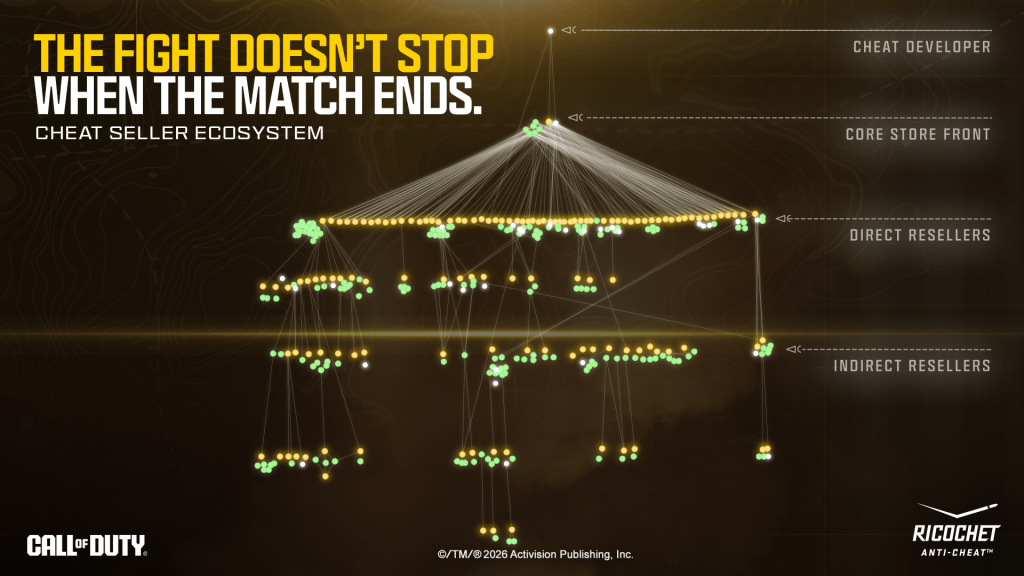
At the top of the cheating ‘pyramid’, as revealed by Team RICOCHET in a new post, sit cheat developers, some of which are shady, multi-million-dollar organizations backed by heavy investment from unseen agencies.
They manufacture their game-disrupting hacks and use middleman services to get them into the market, never directly marketing the cheats they code and create. The same cheat engines can often surface under many different identities because of this.
But Team RICOCHET is trying to bring that concept to its knees. They’re actively tracking hundreds of vendors and, to date, have disrupted the operations of 375 entities, issuing almost 100 cease-and-desist demands through legal channels.
RELATED – All Call of Duty Games in Order of Release
They’ve directly contributed to the shutdown of 31 primary cheat vendors. The core problem is that when you cut off one head, another viciously surfaces in seconds.
RICOCHET has been evolving its detection layers for years, and now uses software scanning, behavioral analysis, and machine-learning models, along with AI-driven solutions, to spot cheaters in the wild.
But another facet of this issue is the more nefarious activity perpetuated by these wrongdoers. Cheat sellers are known to harvest data, pulling account verification content, IP addresses, hardware fingerprints, emails, and payment details. When you buy cheats, you’re quite literally risking your own identity.
All too often, we see malware-laden cheats turning ‘customers’ into victims, but who really feels sorry for them?
That’s how the cheating industry is worth more than $8.5 billion, per Team RICOCHET’s analysis and investigation. In a single year, one cheater could spend up to $1,000 to stay active, buying new accounts, fresh subscriptions, and resuming cheat packages that might be shut down on one platform and migrated to another.
The economic side of cheating is running wild, and that’s why it’s so hard to fight it. There’s so much money in this business that agencies like Team RICOCHET are fighting sophisticated, global entities that often have more intelligent tools than the anti-cheat teams themselves.
You might have anti-cheat teams of a few dozen developers fighting against cheat coders and manufacturers that can number in the millions at any given point. But Team RICOCHET isn’t giving up that fight any time soon.
Do you think cheaters should face harsher penalties when they’re discovered? Let us know your thoughts on the Insider Gaming Discord server.
For more Insider Gaming coverage, check out all the content coming to Dying Light: The Beast, and don’t forget to sign up for our weekly newsletter

Grant has been gaming for 30+ years and in the industry for 10+. You'll probably find him playing a post-apocalyptic game or an extraction shooter somewhere.
More from Grant Taylor-Hill